Periyar Maniammai University
Vol 4 Issue 20, May 17 - 23, 2013
    Citizen Reporters      |   | Submit Story

Indian rhinos facing threat of extinction: Experts

   By  Sanjeeb Baruah
   Guwahati
18 May 2013
Posted 15-Oct-2012
Vol 3 Issue 41

A thriving market in east and southeast Asia in illegal wildlife products, particularly among cultures that prize the rhino horn for its magical or medicinal qualities, are driving the rhinoceroses to extinction, say experts.

China, Vietnam and Thailand are major consumers of rhino horn, fuelling the mass killing of rhinos across their ranges in India and elsewhere, they said.
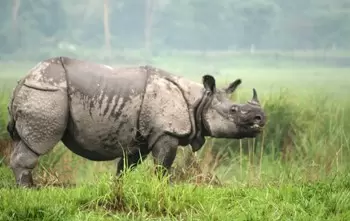
A one-horned rhino at Kaziranga National Park (Photo : Prabal Sarkar/ Wildlife Trust of India)

Assam's Kaziranga National Park, the world's last major refuge of one-horned rhino, saw two massive floods this year. The flooding of the Brahmaputra river wreaked havoc in the park first during July-August and again in September.

Over 600 animals died in the first wave, and about 130 more perished in the second. But not all were drowned. Some rhinos fleeing the flood fell victims to poachers.

"As the reward for rhino horn shot up, many ex-militants have joined the ranks," says a senior official of the Wildlife Crime Control Bureau (WCCB), requesting anonymity.

"Use of automatic weapons is of particular concern, as it shows the poachers' increasing sophistication," he said.

Kaziranga, despite being one of the best-protected reserves in the country, faces a daunting task "because poachers are even ready to face the bullet", said Tito Joseph of the NGO Wildlife Protection Society of India (WPSI).

The 800-plus sq km Kaziranga park, is a world heritage site and is home to elephants, tigers, slow loris and swamp deer, among others.

This year, 15 rhinoceroses were killed in the Kaziranga landscape, said Joseph.

"Poachers cut the tail and ear of the rhino to prove to the buyers that the horn is genuine," he said.

"We believe the rhino horns from recent poaching are still in the country," the WCCB official said.

Border guards and other enforcement agencies have been alerted, he said.

Dimapur town in Nagaland is a hub of this trade, and from there rhino horns are trafficked through Myanmar out of the country.

"China and Vietnam don't have rhinoceroses, hence they source the rhino horn from India. Traditionally, these markets depended on Africa but a new source was always welcome," the official said.

South Africa, another major rhino range country, which earns huge revenues from wildlife tourism, has lost over 400 rhinos to poaching since January.

Despite best security measures in sanctuaries like Kruger National Park, poaching continues.

"This shows the money poachers are being offered," said Joseph. "Rising income of the middle class in consumer countries is fuelling the rhino horn trade," he said.

"Many of these countries do have laws to prevent the sale of wildlife articles, but their enforcement is often lax," said Joseph.

The rhino horn is made up of calcium, melanin and keratin, the same substance as human hair and nails. Calcium deposits make the horn core stronger, and melanin protects the core from the sun's UV rays, experts say.

But some cultures prize the rhino horn for magical qualities, while others used them as dagger handles or good luck charms.

The one-horned rhino (Rhinoceros unicornis) is today found only in India and Nepal. It has been exterminated in Bangladesh. India, with some 2,500 rhinoceroses, is their main home. Nepal has about 370 rhinos.

The African black and white rhinos are bigger bodied compared to their Asian counterparts, but they are equally threatened.

It is estimated that the trade in wildlife body parts is only third to arms and narcotics, a grim reminder of the threats rhinos face. - IANS


Print  |  Email  | 
 Share   

You might also like:

Truth warrior

Karnataka Lokayukta Justice N Santosh Hegde is a crusader for truth. The man who exposed Chief Minister B S Yeddyurappa’s alleged role in the multi-crore mining scam speaks out in an interview

Read More

Home of hope

Home of Hope, which cares for about 15 HIV positive children in Chennai, is supported by close friends, donors, and few corporate bodies, says Mohan Daniel speaking to Shanmuga Priya R

Read More

Stephen Cars
Person of the Year
adyar bakery
 
Builders and Property Developers


Popular Stories

Disaster loo

Sanitation is the last thing crisis managers provide to people displaced from homes by disasters. Now a former banker, Promita Sengupta , has come up with a quickly deployable toilet that has come handy for NGOs, says Kavita Kanan Chandra

Read More

Herbal killer

A young innovator from Tamil Nadu aspires to create 50,000 jobs by popularizing his herbal mosquito repellent, ‘Hermo’, which repels mosquitoes effectively but does not harm humans as it is non-allergic and non-toxic, says    P C Vinoj Kumar

Read More

Rural tours

Village Ways, launched by Manisha and Himanshu Pande on the principle of responsible tourism, helps urbanites have a real feel of rural life. Not a ‘home stay’ kind, the enterprise ropes in the locals as partners, says Kavita Kanan Chandra

Read More

Papa & papa

Social work is no pizza business, it requires commitment and passion says Vidyaakar, who has been running a home in Chennai, Udhavum Karangal, for 30 years. Catherine Gilon met the Papa, who now has 1263 people, 314 of them kids, in his care

Read More

Miracle road

A young IAS officer mobilized Rs 40 lakh through Facebook to build a road in Manipur, earning the sobriquet ‘The Miracle Man’. Gaurav Sharma met Armstrong Pame to find out why he wanted to build the 100 km ‘People’s Road’ and how he did it

Read More

Whirring for poor

A grassroots innovator, Dharamveer Kamboj, has changed the lives of people from the barren land of Rajasthan to the dense forest of Nagaland by designing a food processor. Kavita Kanan Chandra explains how it works well for women and tribes

Read More

Freezing migration

They call him the ‘glacier man’. Chewang Norphel of Ladakh built 12 artificial glaciers that prevented farmers in high altitudes from moving out of the villages in search of alternative livelihood. Akash Bisht profiles the visionary with grit

Read More

Clothing the poor

Identifying clothing as a basic necessity after food and shelter, a journalist couple, Anshu Gupta and Meenakshi, started a social venture, Goonj, providing ‘Cloth for Work’. Then they did more, reaching parts of 21 states, says Roohi Seghal

Read More

Dung papers

A father-daughter duo is turning rhinoceros dung into paper, which in turn has turned out to be an economically lucrative venture. Kavita Kanan Chandra explains how Elrhino, the micro-enterprise, will also help in wildlife conservation

Read More

Cutting thru penury

Driven by a desire to succeed after he was told that he did not deserve a Pilot pen in class V, Ramesh Babu who worked his way up to own a fleet of 127 cars, including a Rs 3.3 crore Rolls Royce, yet remains a hairstylist, says P C Vinoj Kumar

Read More
 
Kudos image

“The Weekend Leader is doing a great job by publishing these positive stories. Our society needs these stories to inspire itself.”

Navin Gulia, Motivational Speaker and Author More Kudos
 
Archives  |   Columns  |   About Us  |   Contact Us  |   Feedback  |   Response  |     |   Cheers!  |   Support Us
© Copyright The Weekend Leader.com, 2010. All rights reserved.