Army convoy had stopped at Chowdhary Gumai on ATR and made the naked women dance

By
Zubair Ahmed
Port Blair
22 May 2013
Posted
16-Jan-2012
Vol 3 Issue 2
The Jarawa dance video, which created a hue and cry in the international and national media and forced the Government of India and Andaman and Nicobar Administration to order a probe, was actually shot by a group of army personnel on the Andaman Trunk Road (ATR) connecting Port Blair with Diglipur.
In an independent investigation by The Light of Andamans (LOA), it has come to light that police and ground staff of Andaman Aadim Janjathi Vikas Samithi (AAJVS) - an autonomous body that looks after welfare of the Jarawa tribe – had nothing to do with the video.
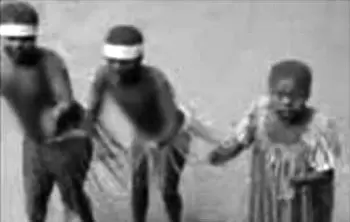
The Jarawa dance video was shot by army personnel, according to the women shown in the video (Photos courtesy: LOA)
Contrary to the statements released to the media by the Administration, the video was shot three years back on 6th November 2008, in which two vehicles - a truck and a gypsy belonging to the army were involved.
In a release, the Andaman DGP S B Deol, had said that the video was 10 years old and there were no cop in the video. He had also pointed out that a man in a camouflaged uniform was seen in the video.
However, he did not mention any role of defence personnel. LOA has identified the Jarawa women and girls featured in the video, which was shot at a place about 8 kms from Jirkatang, known as Chowdhary Gumai on the ATR.
There were six Jarawa women including a pregnant lady, who were shown fully naked in the video. LOA has identified five of them – Thadul (16) daughter of Thadang, Ecnchobecha (14) d/o Thadang, Cheddatokula (35) wife of Whaydom, Aninja (13) d/o and Whaydom Enepowaiele (21) w/o Mahe.
Enepowaiele was 7-8 months pregnant when the video was shot. She gave birth to a baby girl Wane on 6 February 2009.
Traffic on the ATR is regulated and vehicles were allowed only in convoys at eight different times in a day, when the video was shot. Two-wheelers are not allowed on the stretch. Each convoy is accompanied by police escort vehicles. The ATR passes through a 50 km Jarawa Reserve area, where the video has been shot.
According to information available with LOA, on the day the video was shot a military truck had crossed the check post at Middle Strait with special permission after the last convoy had left the point.
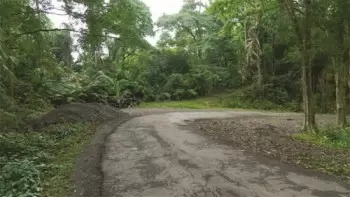
Chowdhary Gumai, where the video was shot
Enepowaiele, the pregnant woman in the video, who is 24 years now has confirmed to a reliable source about the incident and the involvement of army personnel in it.
However, this does not give a clean chit to the police force present at Middle Strait who allowed the military truck to pass after the last convoy had departed from their check post.
The thumb rule is not to allow anybody except AAJVS, Police and Forest personnel dealing with the protection and welfare of Jarawas of specific territorial jurisdiction.
This raises a serious question on how army personnel, who were returning from Baratang could stop inside the Reserve and shoot the video exploiting the vulnerability of a tribe who are at crossroads, unaware of the dangers it poses to their life and culture.
Interactions such as these have given rise to the demand that the ATR be shut down so that the Jarawa tribe may live in peace
Soon after the expose by news channels, Shakti Sinha, Chief Secretary, Andaman and Nicobar Island Administration had reacted to the episode saying that over the past decade, the population of the Jarawas has increased for the first time since they first came into contact with the outside world 150 years ago. He also said that the Tribal Reserve area has been increased from 847 sq kms to 1028 sq kms.
Meanwhile, the recent video has reopened the discussion on whether the ATR is a threat to the Jarawas and whether it should be shut down in the interest of the tribals.
We want to change the world. This is how Nisha Agrawal, head of Oxfam India, sums up the plans of her charitable organisation with an annual budget of Rs 100 crore. Partho Burman meets her
People magazine of the Time magazine group, which usually features celebrities and film stars, has profiled Anand Kumar, founder of Super 30, hailing him as a ‘People’s Hero’. A report
Solar Impulse, the solar-powered airplane with the weight of a small car, developed by Swiss pioneers Bertrand Piccard and André Borschberg, is attempting a world record in solar aviation
The wife of a porter, 38-year-old Sanuja Rajan, has won Rs. 1 crore in a TV reality show in Kerala. Life has come full circle for the woman, who has endured many hardships, says Sanu George
The scenic East Coast Road that connects Chennai with several tourist destinations has turned into a death trap due to increase in number of accidents. KP Subramanian analyses the problem
A small army of friends have joined hands to strengthen TWL under the banner of the Friends of Positive Journalism, a forum that was launched two years ago. P C Vinoj Kumar has the details
Ravi Kalra is a former taekwondo instructor whose NGO cares for senior citizens, and mentally challenged people. He carries on with his work though his family deserted him, says Rahul Vaishnavi
Is Sri Lanka’s High Commissioner to India, Prasad Kariyawasam playing a dangerous game of dividing Indians? He has been accused of instigating the North Indians against the people of Tamil Nadu
Chief Minister J Jayalalithaa has written to Prime Minister Manmohan Singh that IPL matches involving Sri Lankan players, umpires and other officials should not be played in Tamil Nadu
Indian cricketers, including Dhoni and Sachin, let their hair down after their historic whitewash of Australia by zooming and careening around the Buddh International Circuit in Greater Noida
Student outfit warns IPL against fielding Sri Lankan players in Chennai. Political parties echo the demand as the ‘Boycott Sri Lanka’ campaign gains momentum and casts its shadow on cricket
The Weekend Leader captures the ongoing students’ struggle in Tamil Nadu in photographs, even as the protests appear to be taking the shape of a popular movement for creation of Tamil Eelam
A set of young girls in a sleepy hamlet in Assam stuck to their passion, playing soccer, despite societal disapproval. Today, many of them have brought fame to their village, says Abdul Gani
Sanitation is the last thing crisis managers provide to people displaced from homes by disasters. Now a former banker, Promita Sengupta , has come up with a quickly deployable toilet that has come handy for NGOs, says Kavita Kanan Chandra
A young innovator from Tamil Nadu aspires to create 50,000 jobs by popularizing his herbal mosquito repellent, ‘Hermo’, which repels mosquitoes effectively but does not harm humans as it is non-allergic and non-toxic, says P C Vinoj Kumar
Village Ways, launched by Manisha and Himanshu Pande on the principle of responsible tourism, helps urbanites have a real feel of rural life. Not a ‘home stay’ kind, the enterprise ropes in the locals as partners, says Kavita Kanan Chandra
Social work is no pizza business, it requires commitment and passion says Vidyaakar, who has been running a home in Chennai, Udhavum Karangal, for 30 years. Catherine Gilon met the Papa, who now has 1263 people, 314 of them kids, in his care
A young IAS officer mobilized Rs 40 lakh through Facebook to build a road in Manipur, earning the sobriquet ‘The Miracle Man’. Gaurav Sharma met Armstrong Pame to find out why he wanted to build the 100 km ‘People’s Road’ and how he did it
A grassroots innovator, Dharamveer Kamboj, has changed the lives of people from the barren land of Rajasthan to the dense forest of Nagaland by designing a food processor. Kavita Kanan Chandra explains how it works well for women and tribes
They call him the ‘glacier man’. Chewang Norphel of Ladakh built 12 artificial glaciers that prevented farmers in high altitudes from moving out of the villages in search of alternative livelihood. Akash Bisht profiles the visionary with grit
Identifying clothing as a basic necessity after food and shelter, a journalist couple, Anshu Gupta and Meenakshi, started a social venture, Goonj, providing ‘Cloth for Work’. Then they did more, reaching parts of 21 states, says Roohi Seghal
A father-daughter duo is turning rhinoceros dung into paper, which in turn has turned out to be an economically lucrative venture. Kavita Kanan Chandra explains how Elrhino, the micro-enterprise, will also help in wildlife conservation