
Sri Lankan state, global powers and Tamil genocide

20-October-2011
Vol 2 | Issue 42
Introduction
It is often stated that the 2002 Ceasefire Agreement (CFA) and the Memorandum of Understanding (MOU) between the Government of Sri Lanka (GoSL) and the Liberation Tigers of Tamil Eelam (LTTE) came into effect because of the international pressure that was exerted on the LTTE after 9/11.
But the facts prove otherwise. That is, fundamentally, the peace process was entered into, 2002 CFA/MOU was signed, not because of international pressure, but because of the balance of power between the two parties in conflict. Why do I say this?
 |
|
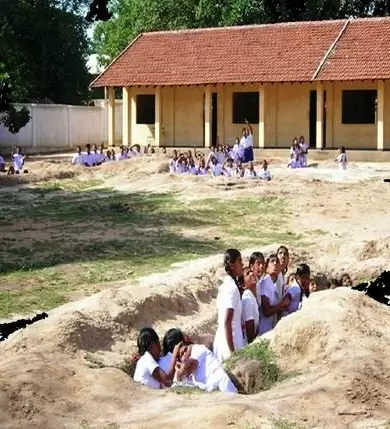
The international community stood as a mute spectator as the Sri Lankan air force bombarded Tamil civilian targets with impunity during Eelam War IV (File photos: Save Tamils Movement)
|
How did the 2002 CFA/MOU come about?
The LTTE, as prelude to a possible peace process, declared a unilateral ceasefire as far back as 2000 December. However, this was not reciprocated by the GoSL.
Instead the GoSL, attempted to resolve the issue by asserting Sinhala supremacy while carrying out a new round of military operations in the Tamil region.
However, this was successfully repulsed by the LTTE. Later, the LTTE’s well-coordinated surprise attack on the country’s main airport and air force base in June 2001 (before 9/11!) destroyed a large number of military and civilian aircrafts (without causing a single civilian causality) and brought the country’s economy to a severe crisis.
It is interesting to note that the civilian and military airports are located next to one of Asia’s biggest Free Trade Zones where workers (largely Sinhala women) do not have a right to trade unions, but the foreign and local investors have tax free business transactions as part of the neo-liberal economy.
After the above attack, as the foreign investors began to express their serious concerns about the economic and political stability of the country, the Sri Lankan government entered into a massive political crisis. How?
The neo-liberal programme in Sri Lanka was initiated during the same period as in Chile under Pinochet in the 70s and it was also during the same period that Sri Lankan military forces began its process of modernising itself mainly targeting the emerging Tamil militancy in the north and east of the country (This military, well practised against the Tamils made short work of the Sinhala anti-government militancy during 1987-1989).
During the period from 1977 to 2002, while the Sri Lankan governments continued to build its military might and at the same time expediting its neo-liberal agenda, the LTTE which represented the Tamil national movement had emerged as a formidable politico-military force to the extent of controlling 70% of the Tamil areas and was struggling to build up a functioning civil-administration.
It strived to provide for welfare, health care, education, gender equality, environmental protection, child care, agriculture, fisheries, local industries, art, music, culture, law and order, policing etc.
By mid 2001 not only the Sri Lankan economy has been badly affected (due to accumulating burden of long term military expenditure and the economic crisis brought about by the LTTE’s June 2001 attack on the airport), but also the narrow Sinhala Buddhist nationalist ideology that was necessary to maintain the Sinhala supremacist unitary state structure had been severely challenged by the LTTE’s de facto control of large parts of the north and east where majority of Tamils live.
At the parliamentary elections in December 2001, the war weary Sinhala masses helped the opposition which fought on an anti-war ticket, into power. Subsequently when the LTTE declared another unilateral ceasefire, the newly elected United National Party (UNP) led government reciprocated.
The USA, EU, Japan and Norway (the facilitator) formed the so called 'Co-chairs' of the peace process expressing the wide international support for these historic developments in Sri Lanka.
In February, 2002, the CFA/MOU was signed recognising the line of control between the two territories and later peace talks began seeking to establish structures to demilitarise, resettle and rehabilitate the war affected regions.
It is in this sense that I argue this agreement came into effect not because of international pressure, but fundamentally because of local power dynamics. In a way this was a historic moment where, the sovereignty of this island was at its peak, because the British constructed unitary state structure, the real source of the conflict in the island and the hold the West had on Sri Lankan state was at its weakest. The government of Sri Lanka decided to talk with the LTTE as a result of this new situation.
The International Pressure was on the 2002 CFA/MOU!
However, different powers supported the peace process for different reasons. Some, like the USA and the British, wanted breathing space to rearm the Sri Lankan state and to change the military balance in its favour.
In fact, the international pressure started mounting on the LTTE soon after the CFA/MOU was signed. The pressure was on the agreement which had radically challenged the neo-colonial unitary state and its Sinhala Buddhist Ideology.
From the very beginning of the implementation of the agreement the American/British governments with the tacit approval of the Indian government made every attempt to strengthen the power of the Sri Lankan government relative to the LTTE.
 |
|
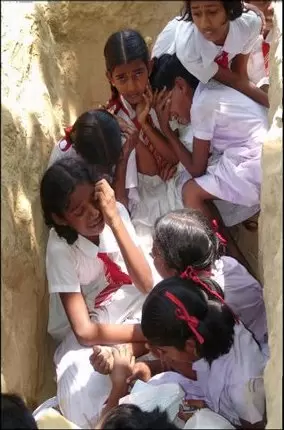
The Lankan army terrorised the Tamil population with indiscriminate shelling of schools, hospitals and religious places
|
This gave the government a signal that it could backtrack on the implementation of the CFA/MOU and gave succour to the ultra-nationalist forces who were opposing the whole agreement.
It is because of this international manipulation that the Sri Lankan security forces got well equipped with the blessing of global powers, and Sinhala Buddhist ultra-nationalist forces were given a moral boost.
As a result, a new government was formed with the support of the ultra-nationalist forces under the Presidency of Mahinda Rajapakse in 2005 who vowed to the Sinhalese that he would ‘unite’ the country by abrogating the CFA/MOU, in other words that he would strengthen the unitary state.
Under pressure from the American and British governments the EU banned the LTTE in 2006.
With the EU, seen by most observers as the strongest supporter of golden rule of the peace process, the accordance of parity of status to both sides of the conflict, breaking this cardinal rule - encouraged the GoSL to renege on peace process and thereby paved the way to re-establish the endangered Sinhala Buddhist unitary state. What happened after that?
Since then until May 2009 the massive military operations that were carried out by the Sri Lankan security forces against the Tamil region have resulted in the first genocidal massacre of the 21st century.
What was in operation was not only the Sri Lankan state’s brutal war against the Tamil resistance, but also the propaganda war of the Sri Lankan state and the global powers - which was operating in full swing.
As the massive fire power was directed towards the Tamil region, the people continued to move deeper into the LTTE-controlled areas as they have been doing throughout the last 30 years.
Contrary to the allegation that the LTTE was using the Tamil people as a human shield, the LTTE was coming between the advancing Sri Lankan army and the Tamil people - providing a shield to the people.
However, as the Sri Lankan military’s fire power continued indiscriminately, targeting civilian settlements, churches, temples, schools and hospitals, the local and global propaganda machine was spreading the news that the LTTE is holding the people as a human shield and that the people should be allowed to cross to the Sri Lankan military controlled areas and the LTTE should surrender.
Few months of propaganda have distorted not only the political truth of 60 years of Tamil resistance but also the 6 years old CFA/MOU? What is the history of Tamil resistance?
The author Dr. Jude Lal Fernando is Research Fellow and Lecturer, Irish School of Ecumenics, Trinity College, Dublin, Ireland
The second and concluding part of this article will be published next week on 28 Oct 2011
Also Read
- 0
-

-

-

-


Trending Now: