
A campaign that revisits the theme of violence against women in locations across India

22-December-2012
Vol 3 | Issue 51
It was the night of March 29, 1978. A young woman in Hyderabad, Rameeza Bee, was subjected to rape by three policemen and her husband beaten to death for resisting them. Public outrage and frenzy brought the city to a halt the following day.
Rameeza Bee is just one more name in the long, never-ending roll call of survivors of violence against women in India. That egregious assault on her is only one among countless others – many of them unaccounted, unacknowledged, unpunished – that women in the country have fought against.
 |
|
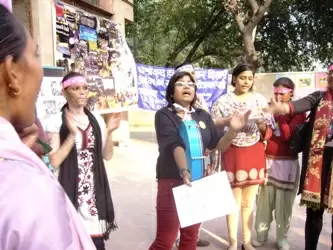
With the slogan ‘Strike, Dance, Rise’, the 'One Billion Rising' campaign has struck a chord with the younger generation (Photo: WFS)
|
Violence has, in fact, been a major trope in women’s activism in the country and today, almost 25 years after that Hyderabad episode, that same battle is still on. The intervening years may have seen the passage of progressive laws and the building of movements against such crimes, but it is also true that the violence itself has taken on newer forms and has been manifesting itself in ever more numerous corners of the country.
Just one figure captures this reality. Going by the National Crime Records Bureau figures, incidents of rape in India have risen by 873 per cent between 1953 and 2011.
Over the last few months, the One Billion Rising (OBR) campaign has revisited the theme of violence against women in locations all over India, ranging from Madurai to Delhi and Mumbai to Bhubaneswar, and has done this in ways that reflect the creativity and energy of young activists and the steadfast commitment of an older generation of feminists.
The campaign began with a global call from American playwright and activist, Eve Ensler, to people around the world – men and children included - to root out violence against women and join in a global day of action on February 14, 2013. Over 5,000 groups in 161 countries supported the idea, whether they were resisting mining in the Philippines or female genital mutilation in Kenya; whether they were supporting survivors of acid attacks in Bangladesh or demanding new legislation on women’s rights in the UK.
Kamla Bhasin, whose organisation, Sangat, is the South Asian coordinator for the OBR campaign, argues that global campaigns are important because they infuse energy into national movements.
“I always feel that normally when I am working, I am like a drop of water. But once I am part of a global campaign, I suddenly feel like an ocean. Let’s spread the idea, stand up together against violence, using all the imaginative and cultural resources at our command,” she says.
Interestingly, even groups that have voiced reservations about foreign campaigns have come around to this view. As Gargi Chakravartty, working president of the National Federation of Indian Women, the women’s wing of the Communist Party of India, puts it, “It’s high time that women, irrespective of their affiliations, come together and rally around the central issues of the day. The OBR campaign is one such process, whether you call it a celebration or a struggle!”
There is widespread recognition that attacks and assaults on women, whether within the home or in the public space, are embedded in existing social structures. While Chakravartty argues that poverty itself amounts to structural violence, Vimal Thorat, convenor of the All India Dalit Mahila Manch, believes that campaigns like OBR should also recognise the violence perpetrated by the caste system.
Elaborates Thorat, “Take the Mirchpur case in Haryana, where a 70-year-old dalit man and his physically challenged daughter were set ablaze in 2010. It had all begun when a dog belonging to a dalit family was beaten. When the family remonstrated, the local Jat community retaliated by setting the entire dalit basti on fire. That is the kind of violence we face in India today and women invariably are the soft targets.”
Women being soft targets was chillingly demonstrated in an incident that took place on July 9, 2012, when a young teenager emerging from a local pub was set upon by a mob of young men on the streets of Guwahati, Assam.
Monisha Behal, chairperson of North East Network, looks back on that incident, “For us women of the Northeast, who have been working on issues of violence against women for decades now, what happened to that young girl was deeply disturbing because it demonstrated that women in Assam do not have any space in public life. That’s why we need to come together to say, ‘Enough!’”
‘Enough!’ - That is also a message that Bawri Devi, an activist with Action India in the resettlement Delhi colony of Jahangirpuri, would like to convey. “I am a poor woman who migrated to Delhi from Rajasthan. We were finally resettled in this colony on the margins of Delhi. Every street here has a story of violence against women. Today, this violence is taking on so many different forms and we will have to fight it in different ways as well if it has to end.”
Rashmi Singh, executive director of the Government of India’s National Mission for Women, is heartened by the effort that has gone into the OBR mobilisation. “This is about bringing different stake-holders together in a spirit of oneness, and I believe for this you also need to bring the government into the picture, because government officials should realise that violence against women is an extremely important subject of governance.”
What is singular about the OBR campaign is the energy it unleashed, a tribute particularly to the young people who have signed on. They have choreographed dances, composed slogans, struck drums, made short films, and used the internet space in creative and impactful ways.
At one point during the Delhi launch of the OBR campaign on a late November evening, noted classical and folk singer, Vidya Shah, broke into a song that had everybody in a large auditorium throw up their hands in dance. In that instant the struggle against violence had become a celebration of the will to fight it.
Anne Stenhammer, UN Women’s Regional Programme Director, believes that tough campaigns of this kind need an enjoyment quotient built into them. “At one point I was in Kosovo during the war. One of the insights I had gained then was this: Because the struggle to rebuild a war-shattered region is, by its very nature, a long-term one, it is important for those involved in that re-building process to enjoy life, re-charge themselves. That’s why the fun element of the OBR campaign is very, very important.”
With its slogan, ‘Strike, Dance, Rise’, when the body itself becomes a medium of resistance, the OBR campaign is as much about building bridges and friendships as it is about a creating a common future free of the threat of violence against women - Women's Feature Service
- 0
-

-

-

-


Trending Now: