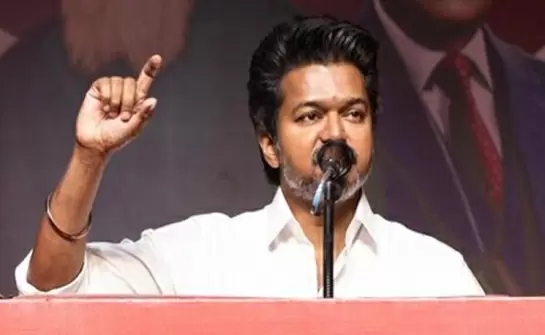

India Is No. 1 in Global Remittances And Education Is the Reason, Says Dr G. Viswanathan
TWL Bureau
| Chennai
07-January-2026
Vol 17 | Issue 2
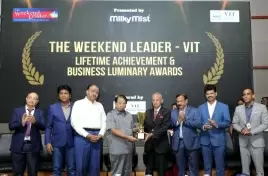
Addressing students at the Vellore Institute of Technology (VIT) Chennai campus after presenting The Weekend Leader–VIT Lifetime Achievement Award to Brigadier B. K. Ponwar and the Business Luminary Award to Ma Foi K. Pandiarajan, Executive Chairman of CIEL HR Group, Dr G. Viswanathan, Founder-Chancellor of VIT, highlighted a little known but a crucial fact about India’s economy: India is the number one country in the world when it comes to remittances.
“Even with our limited Gross Enrolment Ratio of around 28 or 29 percent, Indians are working all over the world,” Dr Viswanathan said. “Our students from VIT alone are present in 84 countries.”
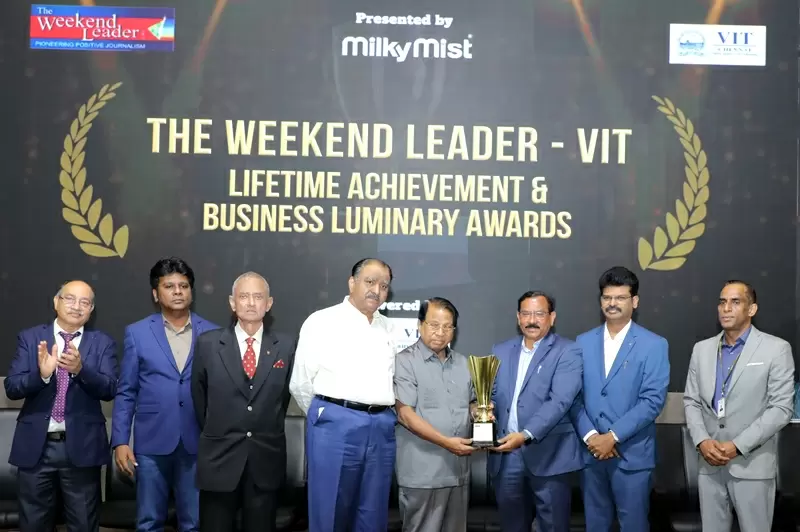
| Dr. G Viswanathan presents The Weekend Leader - VIT Lifetime Achievement Award to Brigadier B K Ponwar (Photos: Bosco) |
Explaining the scale of this global contribution, he said, “India is number one in the world in remittances. In 2024 alone, remittances amounted to about Rs 12 lakh crore.” He pointed out that Kerala, Tamil Nadu and Maharashtra together accounted for nearly 50 percent of this amount, while the rest of the country shared the remaining half.
“The reason again is education,” he stressed.
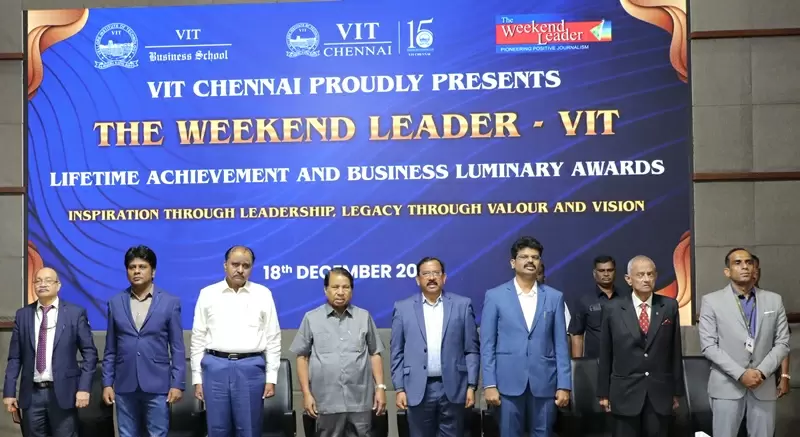
Dr Viswanathan expressed happiness at the selection of the awardees and noted that the dais was represented by all the pillars of democracy.
“Today on this stage, we have representatives of the police, the army, the press and media, and also politics, because Pandiarajan represents both business and politics, and education.” Pandiarajan, Executive Chairman of CIEL HR Group, was a former minister in Jayalalithaa’s cabinet.
Pointing to The Weekend Leader’s role, he added, “We always say that the legislature, the executive and the judiciary are the three pillars of democracy. The fourth pillar is the press and media.”
“So today,” he said, “we have everything here that a country requires. The only question is how we are going to function and how we are going to make this country great.”
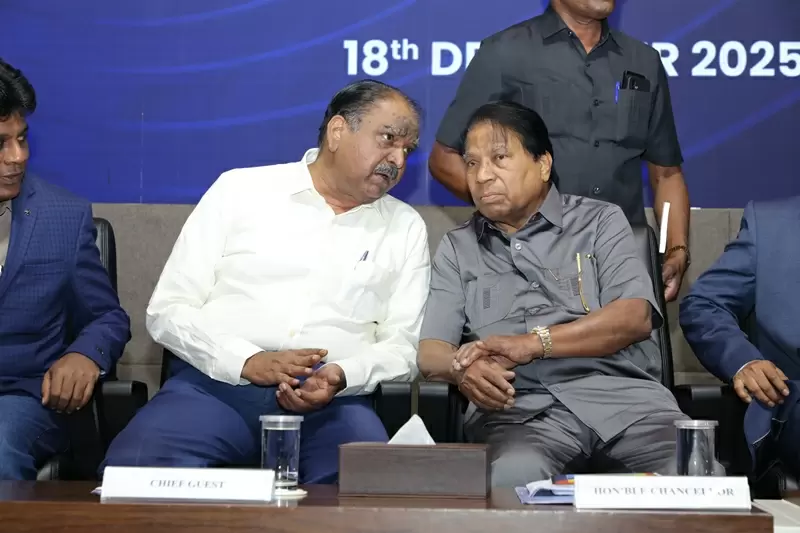
| Dr G. Viswanathan and former Karnataka DGP Dr Shankar Bidari share a moment of conversation on the dais |
While acknowledging India’s progress, Dr Viswanathan cautioned against complacency. “At present, there are constant attempts to divide people - by caste, religion, politics, language, and so on,” he said. “In spite of this, the country is growing. But the growth is not even. It varies from State to State.”
“There is also growing inequality in this country,” he added, “which we are not recognising adequately.”
Referring to recent global rankings, he said, “This year, in 2025, India overtook Japan in terms of total GDP by a small margin, and we have become the fourth-largest economy in the world.”
However, he urged students to look deeper. “When we look at per capita income, our ranking is around 140 in the world. Japan’s per capita income is almost twelve times that of India. Ours is around $2,900, while theirs has crossed $36,000.”
“These are the issues I want young people, especially those studying business, to understand,” he said.
Returning to the theme of education, Dr Viswanathan told students that India’s global workforce and the massive remittance inflow did not happen by accident.
“Wherever education levels are higher, per capita income is higher,” he said. “There is no exception.”
Drawing a striking comparison, he said, “Take California in the United States. It is one among the 50 states. Its population is only about four crore, but its total GDP is almost equal to that of India, which has 146 crore people.”
“How is this possible?” he asked. “The answer is education.”
He pointed out that California’s higher education enrolment stood at around 88 percent, while India’s Gross Enrolment Ratio - the percentage of students between 18 and 23 who have access to higher education - remained at about 28 percent.
Dr Viswanathan was forthright about where the responsibility lay. “We are very backward in higher education because both the Union Government and the State Governments do not spend adequately on education,” he said.
“In this country, higher education depends largely on parents,” he added. “If parents are unable or unwilling to spend on education, what will happen? Only three or four percent of people will get educated.”
Sharing figures from VIT itself, he said, “In the Vellore campus alone, out of 44,000 students, only about 700 receive government grants or support. This must change.”
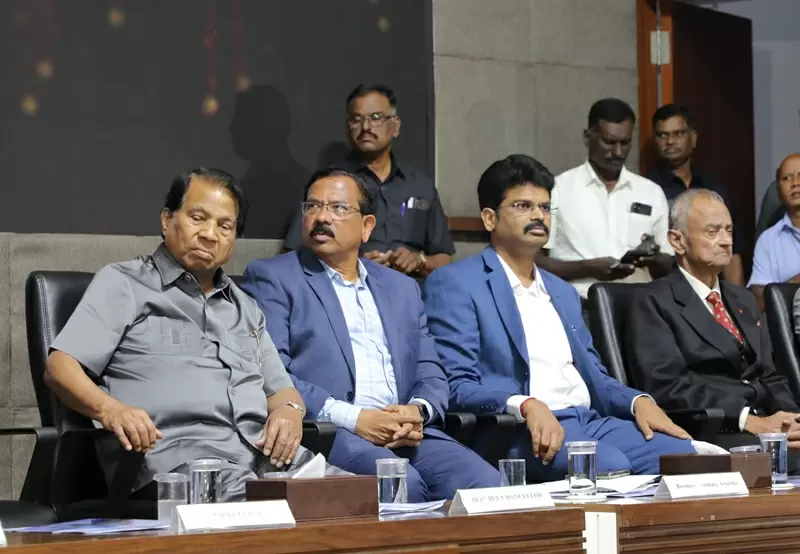
| The awards ceremony turned into a platform for reflection on India’s future |
“Any welfare State must spend on education and health,” he said. “Only then can a country progress.”
Dr Viswanathan emphasised that education had a multiplier effect on the economy. “No doubt, India is growing,” he said. “But we can grow much faster if we concentrate on education.”
“Education leads to industrialisation, higher production, manufacturing growth and increased exports,” he explained.
To underline the link between education and income, Dr Viswanathan compared Indian States.
“Bihar has a population of about 13 crore,” he said. “Kerala’s population is only about 3.5 crore.” While Kerala’s per capita income stood at around $3,800, Bihar’s was about $810.
He cited another example: “Uttar Pradesh has a population of around 24 crore, which is three times that of Tamil Nadu. Tamil Nadu’s per capita income is about $5,400, while Uttar Pradesh’s is around $1,500.”
“The national average is around $2,900,” he added. “These differences are not accidental,” he said. “The reason is education.”
Dr Viswanathan also spoke candidly about what he described as India’s three national diseases.
“Tax evasion, black money and corruption,” he said. “Due to tax evasion alone, we lose around Rs 8 lakh crore every year. Due to corruption, we lose around Rs 6 lakh crore every year.”
“Black money is difficult to estimate,” he added. “Some say it is 20 percent, some say 30 percent, and some even say 50 percent of the money in circulation.”
Referring to money taken abroad, he said, “Earlier we were told there were 72 such people. Now they say it is around 30 or 40. It is not easy to bring them back.”
“You are going to be the future leaders and future citizens of this country,” Dr Viswanathan told the students. “You must take care of these issues.”
| Dr G. Viswanathan shared his thoughts on truth, media and public responsibility |
“Education, good governance and ethical behaviour are essential if India is to become an advanced country,” he said.
Reflecting on politics, he remarked, “Earlier, people were given importance. Today, money is given importance.” Recalling his own experience, he added, “I spent Rs 50,000 to become a Member of Parliament in 1967. Today, even Rs 50 crore is not enough.”
In his closing remarks, he turned to the media. “Truth is becoming very difficult to find,” he said. “If you read five or six newspapers, you will have to search hard to find the truth.”
He urged The Weekend Leader “to help people understand what is true and what is false,” before congratulating both awardees once again and concluding his address.
- 0
-

-

-

-


Trending Now: