
Channelizing a destructive energy for constructive use did not happen so easily

By
Kavita Kanan Chandra
23 May 2013
Posted
09-Nov-2012
Vol 3 Issue 45
None imagined that the ‘destructive’ pine needles which caused massive forest fires in the central Himalayan region of Uttarakhand would someday be spoken of as a source of electricity.
But one man, Rajnish Jain, dreamt that he could channelize the destructive energy of the pine needles into constructive use.
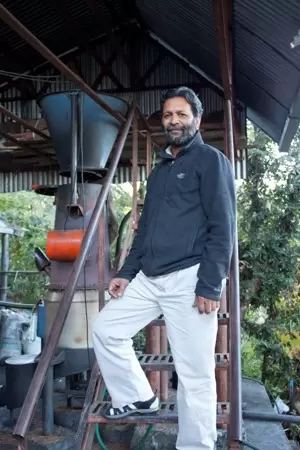
Rajnish has plans to install 20 power plants in next five years using pine needles
Rajnish, who was working for rural development through his organization ‘Avani’ in Berinag village in Pithoragarh district, has developed the technology to use the pine needles for a biomass gasifier to generate electricity.
The power plant he has set up produces 9 KW of electricity and is seen as a major technological breakthrough that could go a long way in controlling forest fires in the region, besides producing electricity to meet local needs and providing jobs for the people.
Since the mid 1990’s, Rajnish has been engaged in various rural development programs, capacity building, solar energy projects and livelihood generation programs for the local population.
His wife Rashmi, co-founder of Avani was always by his side. As chairperson of the producers’ cooperative which is into making natural fibre, naturally dyed silk and woolen textiles, she plays an active role in rural empowerment.
“It was the forest fires that made us take notice of pine needles as a potential source of energy,” said Rajnish.
There are large tracts of pine forests in Uttarakhand and these trees shed a lot of pine needles during summer. These pine needles, which catch fire easily in hot conditions, have destroyed huge forests.
Rajnish said people tried making charcoal from pine needles but that did not take off since the village folks were not willing to pay for it, as fuel – read firewood - was readily available in the forest.
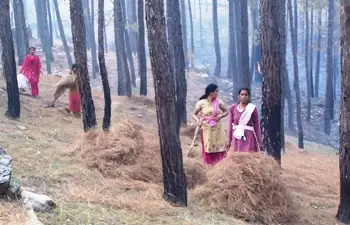
Women collecting pine needles
The idea of using biomass gasification as a technology for generating electricity hit Rajnish when someone spoke about the potential of pine needles as a feedstock for gasifier in a conference on renewable energy.
When he shared the thought with the villagers, everyone laughed at the idea. But he let his logic overrule all doubts and scepticism. He knew that pine needles had tremendous energy and biomass gasification was the right technology to harness its tapped energy.
There were few operational problems, though. It took them three years to address the technical issues and get the project up and running. The result was a 9kw plant that could meet the needs of about hundred people.
Rajnish said the pine needles are slender and approximately 25 cm in length. The collection from 1-2 hectares of forest could provide electricity to fifty people and provide quality charcoal for cooking to five people.
The burning of pine needles in the gasifier produces gas which drives an alternator that generates electricity.
Generating electricity from pine needles would have a ripple effect on the village economy.
Villagers would collect pine needles and they would get paid for it. The forests would be cleared of pine needles thus reducing the chances of fire to a large extent, and the rural youth would be trained to operate the power plants.
Rajnish recalls how it was the call of the serene Himalayas that prompted him and his wife to shift base to Himalayas and start the Kumaon chapter of the Barefoot College (at Tilonia, Rajasthan).
He is from Haryana and his wife Rashmi is from Delhi but they chose to work in the inaccessible villages nestled in the fragile eco-system of Himalayas.
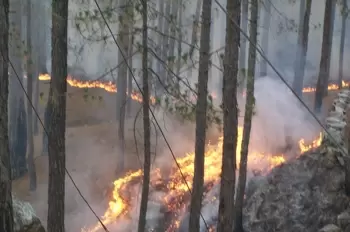
A forest fire
This region didn’t have access to government schemes and most youth migrated to plains in search of job opportunities. It prompted the couple to use their skills in rural development for the benefit of the locals.
Rajnish has plans to install 20 power plants in next five years, each having capacity to generate 100-150 KW of electricity.
He says that an average rural household’s consumption for electricity is low, so each power plant could easily supply electricity to 1000-2000 households in the hills.
Rajnish is optimistic that the pine needles would become a catalyst for change and they would generate about 2000 jobs, restore 4000 hectares of biodiversity, and earn around 60000 carbon credits annually.
India’s ‘rocket woman’ Tessy Thomas, who is being compared to Abdul Kalam, is heading a project to develop Inter-Continental Ballistic Missiles, which can hit targets that are 5,000 km away
An Islamic seminary in Uttar Pradesh breaks the stereotypes associated with madrassas, teaching modern subjects to its students most of whom are girls, finds Abu Zafar
Solar Impulse, the solar-powered airplane with the weight of a small car, developed by Swiss pioneers Bertrand Piccard and André Borschberg, is attempting a world record in solar aviation
The wife of a porter, 38-year-old Sanuja Rajan, has won Rs. 1 crore in a TV reality show in Kerala. Life has come full circle for the woman, who has endured many hardships, says Sanu George
The scenic East Coast Road that connects Chennai with several tourist destinations has turned into a death trap due to increase in number of accidents. KP Subramanian analyses the problem
A small army of friends have joined hands to strengthen TWL under the banner of the Friends of Positive Journalism, a forum that was launched two years ago. P C Vinoj Kumar has the details
Ravi Kalra is a former taekwondo instructor whose NGO cares for senior citizens, and mentally challenged people. He carries on with his work though his family deserted him, says Rahul Vaishnavi
Is Sri Lanka’s High Commissioner to India, Prasad Kariyawasam playing a dangerous game of dividing Indians? He has been accused of instigating the North Indians against the people of Tamil Nadu
Chief Minister J Jayalalithaa has written to Prime Minister Manmohan Singh that IPL matches involving Sri Lankan players, umpires and other officials should not be played in Tamil Nadu
Indian cricketers, including Dhoni and Sachin, let their hair down after their historic whitewash of Australia by zooming and careening around the Buddh International Circuit in Greater Noida
Student outfit warns IPL against fielding Sri Lankan players in Chennai. Political parties echo the demand as the ‘Boycott Sri Lanka’ campaign gains momentum and casts its shadow on cricket
The Weekend Leader captures the ongoing students’ struggle in Tamil Nadu in photographs, even as the protests appear to be taking the shape of a popular movement for creation of Tamil Eelam
A set of young girls in a sleepy hamlet in Assam stuck to their passion, playing soccer, despite societal disapproval. Today, many of them have brought fame to their village, says Abdul Gani
Sanitation is the last thing crisis managers provide to people displaced from homes by disasters. Now a former banker, Promita Sengupta , has come up with a quickly deployable toilet that has come handy for NGOs, says Kavita Kanan Chandra
A young innovator from Tamil Nadu aspires to create 50,000 jobs by popularizing his herbal mosquito repellent, ‘Hermo’, which repels mosquitoes effectively but does not harm humans as it is non-allergic and non-toxic, says P C Vinoj Kumar
Village Ways, launched by Manisha and Himanshu Pande on the principle of responsible tourism, helps urbanites have a real feel of rural life. Not a ‘home stay’ kind, the enterprise ropes in the locals as partners, says Kavita Kanan Chandra
Social work is no pizza business, it requires commitment and passion says Vidyaakar, who has been running a home in Chennai, Udhavum Karangal, for 30 years. Catherine Gilon met the Papa, who now has 1263 people, 314 of them kids, in his care
A young IAS officer mobilized Rs 40 lakh through Facebook to build a road in Manipur, earning the sobriquet ‘The Miracle Man’. Gaurav Sharma met Armstrong Pame to find out why he wanted to build the 100 km ‘People’s Road’ and how he did it
A grassroots innovator, Dharamveer Kamboj, has changed the lives of people from the barren land of Rajasthan to the dense forest of Nagaland by designing a food processor. Kavita Kanan Chandra explains how it works well for women and tribes
They call him the ‘glacier man’. Chewang Norphel of Ladakh built 12 artificial glaciers that prevented farmers in high altitudes from moving out of the villages in search of alternative livelihood. Akash Bisht profiles the visionary with grit
Identifying clothing as a basic necessity after food and shelter, a journalist couple, Anshu Gupta and Meenakshi, started a social venture, Goonj, providing ‘Cloth for Work’. Then they did more, reaching parts of 21 states, says Roohi Seghal
A father-daughter duo is turning rhinoceros dung into paper, which in turn has turned out to be an economically lucrative venture. Kavita Kanan Chandra explains how Elrhino, the micro-enterprise, will also help in wildlife conservation