
Socially conscious Brij Bedi is the man behind the success of Kiran Bedi
By
Nirupama Dutt
18 May 2013
Posted
25-Aug-2011
Vol 2 Issue 34
Brij Bedi does not mind being identified as Kiran Bedi's husband. In fact, he rather likes it. He is proud of his wife's achievements though the couple has lived separately for over three decades. “Behind every successful man there is a woman but I am the man behind a successful woman,” he quips.
His may not be a high-profile success the 'Crane' Bedi way but for the past two decades he has made a difference in activism, Amritsar style: giving scholarships to students, supporting needy sports persons, cleaning up the city, monitoring traffic, running campaigns against obscene posters on the city walls, preserving paintings in the Baba Atal Sahib building in the Golden Temple and, above all providing education to children of drug addicts.
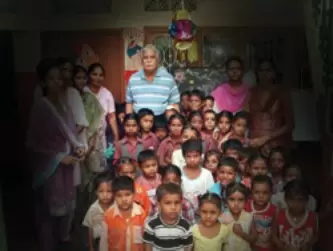
One-man brigade: Brij Bedi's focus is on 'cleaning up' Amritsar and he has done so in more ways than one (Photo courtesy: The Sunday Indian)
Name the cause and there comes Brij Bedi, the handsome debonair man of the 1960s who was born to landed aristocracy. A Master in History from Punjab University, Chandigarh, Brij had many choices – a career in the Army, modelling assignments, or the job of an executive in a leading firm – but he chose to turn to farming soon after Cupid struck Bedi and Kiran Hoshiarpuri on the tennis courts of the Services Club in 1971.
A whirlwind romance was followed by a quiet temple wedding, and soon after Kiran left to be trained as the first woman IPS officer of the country. “I took to farming in my ancestral land at Tugalwala near Gurdaspur,” says Bedi.
Kiran's parents moved in with her and Brij chose to remain in Punjab although he was constantly in touch with his daughter Saina, who was born in 1975. He then moved on to setting up a textile processing machinery unit at Amritsar and was ever ready to help anyone in need and supported artists by holding artists' camps in his factory's premises.
“I made a lot of money and the turning point came in 1994 when I set up a foundation in the memory of my late mother and started giving scholarships to deserving students. It was around this time that the growing traffic in the city and violations started attracting my notice. I started photographing the violations and bringing them to the notice of the authorities,” he says.
This led to Bedi being appointed Chief Traffic Warden in the city with a group of volunteers under him. Since then the grey-haired aristocrat standing on a busy crossing regularising traffic has been a common sight. After that he led a campaign against obscene posters and succeeded in getting an order against pasting of posters on city walls from the Punjab and Haryana High Court.
Though words like ‘maverick’ and ‘eccentric’ are used to describe him, Bedi continued to do what he believed was right. At one point, the Shiromani Gurdwara Parbandhak Committee was all set to whitewash the old wall paintings in Baba Atal Sahib complex and Bedi along with a writer successfully fought for their preservation.
In 2002, a newspaper report on a rundown suburb of the city caught his attention for the headline described it as 'A Colony of Widows'. The head of the family in every other household was a drug addict and in many the bread-winner had died of addiction. He adopted 20 children for education and started a school with the help of a retired teacher of the colony, Master Ajit Singh, in rented premises.
Today, the school, which holds classes up to standard VIII, has 450 children and it owns a premises. “When awards and honours come my way, I avoid them. If an individual cash award comes I give it to the school.” He also arranges for higher education and technical training of the students in other institutions. The Maqboolpura school has featured in a big way in the print media and on celluloid as a unique experiment.
What is the happiest moment for this man who was destined to be a social activist? Let's share the secret: it is when Kiran praises his efforts!
At Chandigarh, which lies at an altitude of 10,000 feet in Himachal Pradesh, families from near the China border who were resettled here post 1962 India – China war have rebuilt their lives
As a child, Jyoti led protests at her orphanage when the quality of food and clothes dipped. Now, the 45-year-old MLA raises her voice against all forms of injustice, says Swapna Majumdar
The wife of a porter, 38-year-old Sanuja Rajan, has won Rs. 1 crore in a TV reality show in Kerala. Life has come full circle for the woman, who has endured many hardships, says Sanu George
The scenic East Coast Road that connects Chennai with several tourist destinations has turned into a death trap due to increase in number of accidents. KP Subramanian analyses the problem
A small army of friends have joined hands to strengthen TWL under the banner of the Friends of Positive Journalism, a forum that was launched two years ago. P C Vinoj Kumar has the details
Ravi Kalra is a former taekwondo instructor whose NGO cares for senior citizens, and mentally challenged people. He carries on with his work though his family deserted him, says Rahul Vaishnavi
Is Sri Lanka’s High Commissioner to India, Prasad Kariyawasam playing a dangerous game of dividing Indians? He has been accused of instigating the North Indians against the people of Tamil Nadu
Chief Minister J Jayalalithaa has written to Prime Minister Manmohan Singh that IPL matches involving Sri Lankan players, umpires and other officials should not be played in Tamil Nadu
Indian cricketers, including Dhoni and Sachin, let their hair down after their historic whitewash of Australia by zooming and careening around the Buddh International Circuit in Greater Noida
Student outfit warns IPL against fielding Sri Lankan players in Chennai. Political parties echo the demand as the ‘Boycott Sri Lanka’ campaign gains momentum and casts its shadow on cricket
The Weekend Leader captures the ongoing students’ struggle in Tamil Nadu in photographs, even as the protests appear to be taking the shape of a popular movement for creation of Tamil Eelam
Buoyed by pro-Eelam freedom protests in Tamil Nadu, V Rudrakumaran, Prime Minister of TGTE, downplayed the US resolution in UNHRC and pitched for an independent Tamil Eelam, says Radhika Giri
Sanitation is the last thing crisis managers provide to people displaced from homes by disasters. Now a former banker, Promita Sengupta , has come up with a quickly deployable toilet that has come handy for NGOs, says Kavita Kanan Chandra
A young innovator from Tamil Nadu aspires to create 50,000 jobs by popularizing his herbal mosquito repellent, ‘Hermo’, which repels mosquitoes effectively but does not harm humans as it is non-allergic and non-toxic, says P C Vinoj Kumar
Village Ways, launched by Manisha and Himanshu Pande on the principle of responsible tourism, helps urbanites have a real feel of rural life. Not a ‘home stay’ kind, the enterprise ropes in the locals as partners, says Kavita Kanan Chandra
Social work is no pizza business, it requires commitment and passion says Vidyaakar, who has been running a home in Chennai, Udhavum Karangal, for 30 years. Catherine Gilon met the Papa, who now has 1263 people, 314 of them kids, in his care
A young IAS officer mobilized Rs 40 lakh through Facebook to build a road in Manipur, earning the sobriquet ‘The Miracle Man’. Gaurav Sharma met Armstrong Pame to find out why he wanted to build the 100 km ‘People’s Road’ and how he did it
A grassroots innovator, Dharamveer Kamboj, has changed the lives of people from the barren land of Rajasthan to the dense forest of Nagaland by designing a food processor. Kavita Kanan Chandra explains how it works well for women and tribes
They call him the ‘glacier man’. Chewang Norphel of Ladakh built 12 artificial glaciers that prevented farmers in high altitudes from moving out of the villages in search of alternative livelihood. Akash Bisht profiles the visionary with grit
Identifying clothing as a basic necessity after food and shelter, a journalist couple, Anshu Gupta and Meenakshi, started a social venture, Goonj, providing ‘Cloth for Work’. Then they did more, reaching parts of 21 states, says Roohi Seghal
A father-daughter duo is turning rhinoceros dung into paper, which in turn has turned out to be an economically lucrative venture. Kavita Kanan Chandra explains how Elrhino, the micro-enterprise, will also help in wildlife conservation
Driven by a desire to succeed after he was told that he did not deserve a Pilot pen in class V, Ramesh Babu who worked his way up to own a fleet of 127 cars, including a Rs 3.3 crore Rolls Royce, yet remains a hairstylist, says P C Vinoj Kumar