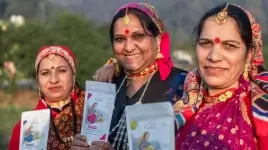
Earthcraft helps hill communities to take their eco-friendly products to the maddening cities

11-January-2013
Vol 4 | Issue 2
Trained in community work at Barefoot College in Tilonia, Rajasthan, Rashmi Bharti and her husband Rajnish Jain moved to the hills in 1997 and set up base at Berinag village in Pithoragarh district of Uttarakhand in the Central Himalayan range.
While Rajnish focused on promoting solar energy in the region through the NGO ‘Avani’ they founded in 1999, Rashmi found her calling in reviving the traditional craft of weaving, spinning and natural dyeing that was once thriving among the Bora Kuthalia and Shauka communities in the region.
 |
|
Rashmi's Earthcraft achieved a sale of Rs 41 lakhs last year
|
In just a few years, her initiative has grown into a full-fledged business providing not only jobs for the locals but also contributing to development of the natural dye industry, which was almost dead and gone.
When Rashmi got into the field of natural dyes, the tiny remnant of artisans left in the occupation was using only limited colours such as golden yellow, yellow and brown in their works. Dye was extracted from two plants - locally called ‘shampatti’ and ‘dolu’ - found in high altitudes. People had also started using chemicals in the process.
The scenario has totally changed now. Earthcraft, the cooperative that Rashmi launched in 2005, deals with a wide range of products including sarees, shawls, stoles, mufflers, home furnishings, and garments for men, women and children.
A wide range of colours are being used in the products. “We have all colours of the rainbow,” says Rashmi.
Dye is extracted from about 80 plants. Some of the sources include indigo, turmeric, tea leaves, onion skin, soap nut leaves, marigold flowers, pomegranate rind, walnut leaves and fruits, rhododendron flowers and leaves among others.
Other sources such as Eupatorium that sprout wildly and prevent growth of other plants have also been identified. Locals would be employed to uproot these plants from the forest. While it would help in regeneration of the forest, the uprooting exercise would provide jobs for the locals and raw material for natural dye.
Earthcraft has already benefitted hundreds of farmers and artisans, majority of them from the Bora Kuthalia and Shauka communities.
The weavers earn around Rs 2500-3000 per month. Spinning is done part-time by ladies who earn about Rs 500 per month. Collection of raw-materials for dyeing is seasonal.
Rashmi says 60 percent of their naturally dyed textiles, woven silk and wool are sold through retail centers, exhibitions and events in domestic market, and the rest exported to countries like Japan, Canada, and France.
“Last year (April 2011-March 2012) we sold more than 3000 stoles and mufflers and 215 shawls. More than 500 Kg of naturally dyed yarn and over 11 litres of water colour were sold and this is set to increase this year,” said Rajendra Kumar Joshi, who works at Earthcraft.
 |
|
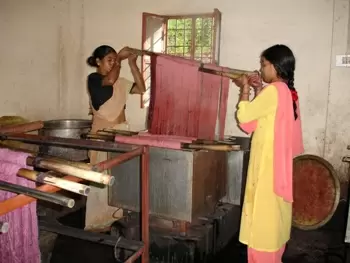
Women engaged in dyeing work
|
The sale was worth Rs.41 lakhs, but the venture is yet to make profit, as funds are just enough to cover the running cost and the increasing budget to create additional infrastructure.
Earthcraft has received several awards and honours, which include: certification for absence of pentachlorophenol and amines, administered by Laboratories of the Textile Committee, Ministry of Textiles in Mumbai, for their indigo and eupatorium dyes; UNESCO Seal of Excellence for Handicrafts, for two of their silk stoles.
On the controversy surrounding hemp farming, Rashmi says there are varieties of hemp with low narcotics level that could be used for fibre production. In the past, local communities used hemp fibre for spinning and weaving, but the current legalities in hemp farming have deterred people from venturing into it.
Hemp seeds are used as spices, stem for fibre and leaves as narcotics (bhang). Nepal has a thriving industry in weaving, making paper and shoes from hemp fibres, says Rashmi.
Earthcraft has identified about 125 acres of wasteland, where they plan to involve local farmers for cultivating plants suitable for making natural dyes. The project would ensure supply of raw materials for Earthcraft, while creating employment opportunities for many.
- 0
-

-

-

-


Trending Now: