Magsaysay award winner Harish Hande lights up rural houses with solar power

By
Kavita Kanan Chandra
Mumbai
24 May 2013
Posted
04-Aug-2011
Vol 2 Issue 31
When a young girl, a topper in the Karnataka Board exams, wrote to SELCO (Solar Electric Light Company India) that she was able to study only because her parents installed solar lights in her house seven years ago, everyone at SELCO was absolutely thrilled.
Nothing brought them more joy than making such a positive impact on someone’s life.
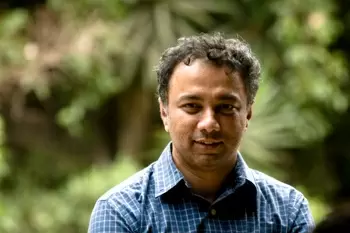
The illuminator: Harish wants to take solar power to another 2 lakh customers in the next five years
For, SELCO is basically a social enterprise, which has been in the business of providing solar power to remote villages and even urban slums that are off the power grid since 1995.
In recognition of the good work, its managing director and co-founder, Dr Harish Hande has been chosen for the 2011 Magsaysay award.
Hande (44), an alumnus of IIT, Kharagpur, felt that small scale standalone installations were the best way to reach remote dark villages in India, while he was in Dominican Republic and Sri Lanka, working for his PhD from the University of Massachusetts.
“My experience in those countries taught me the usefulness of solar systems for the poor. So I changed my thesis to work on rural energy service delivery from solar tracking technology,” says Hande, who started SELCO in 1995 to provide clean sustainable technology to the rural poor, forgoing plum opportunities in the US.
He went from village to village in Karnataka spreading awareness about solar lighting. During the initial days he stayed for days in a village and played the role of a technician too, installing the solar panels himself.
At that time the Government had installed solar powered street lights in rural Karnataka and many lights had failed to work. It made villagers sceptical about solar power and convincing them was a hard job.
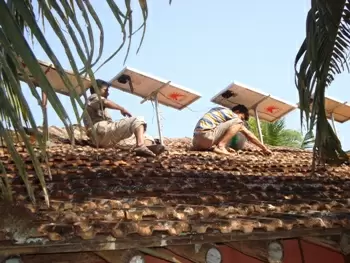
Solar powered: SELCO technicians installing solar panels on a rooftop
However SELCO’s approach of customized products, doorstep financing and a strong service network made them successful. Today, SELCO lights 120,000 households, micro-enterprises and community facilities.
The success of SELCO lights spread by word of mouth and the company does not have a marketing division even now.
“We faced many challenges. One of them was convincing the bankers,” says Hande. It took almost two years till Malaprabha Grameen bank (now Karnataka Vikas Grameen Bank) first relented.
“K M Udupa, the bank manager was the first person to have faith in the venture and financed hundred houses initially. Today the same man is a director at SELCO,” says Prasanta Biswal, who has been with the organisation for the last 6 years.
Slowly other banks followed and when Karnataka started solar loan portfolio in 2001, it gave a tremendous boost to SELCO.
The solar lights could cost anywhere between Rs 8240-Rs 10670. A basic set-up consists of 4-7 watt compact fluorescent lights (CFLs), a photovoltaic (PV) cell mounted on rooftops of huts and a lead acid battery that stores electrical power generated by the PV cell. In this way the solar energy could be used both during the day and night.
“There was no concept of social entrepreneurship when we started in 1994-95. What we wanted to create was a holistic organization with equal importance to social, financial and environmental sustainability. Terms like social enterprise came later,” says Hande.
When rural India uses solar technology, they are powering everything from lights to pumps and in the process conserve fossil fuels, stop climate change and also reduce their carbon footprints.
SELCO’s goal is to reach another 200,000 customers in the next five years and to have a product for a person who earns less than Rs 1000 a month.
Gujarat is all set to develop India’s first tidal energy plant. The state government has approved Rs 25 crore for setting up the 50 MW plant at the Gulf of Kutch, reports Ankur Paliwal
Never take your woman for granted, and show her that you care. These are two tips that Kushbhu Sundar, TWL’s Features Editor, gives for men who would like to prevent their women from straying
Solar Impulse, the solar-powered airplane with the weight of a small car, developed by Swiss pioneers Bertrand Piccard and André Borschberg, is attempting a world record in solar aviation
The wife of a porter, 38-year-old Sanuja Rajan, has won Rs. 1 crore in a TV reality show in Kerala. Life has come full circle for the woman, who has endured many hardships, says Sanu George
The scenic East Coast Road that connects Chennai with several tourist destinations has turned into a death trap due to increase in number of accidents. KP Subramanian analyses the problem
A small army of friends have joined hands to strengthen TWL under the banner of the Friends of Positive Journalism, a forum that was launched two years ago. P C Vinoj Kumar has the details
Ravi Kalra is a former taekwondo instructor whose NGO cares for senior citizens, and mentally challenged people. He carries on with his work though his family deserted him, says Rahul Vaishnavi
Is Sri Lanka’s High Commissioner to India, Prasad Kariyawasam playing a dangerous game of dividing Indians? He has been accused of instigating the North Indians against the people of Tamil Nadu
Chief Minister J Jayalalithaa has written to Prime Minister Manmohan Singh that IPL matches involving Sri Lankan players, umpires and other officials should not be played in Tamil Nadu
Indian cricketers, including Dhoni and Sachin, let their hair down after their historic whitewash of Australia by zooming and careening around the Buddh International Circuit in Greater Noida
Student outfit warns IPL against fielding Sri Lankan players in Chennai. Political parties echo the demand as the ‘Boycott Sri Lanka’ campaign gains momentum and casts its shadow on cricket
The Weekend Leader captures the ongoing students’ struggle in Tamil Nadu in photographs, even as the protests appear to be taking the shape of a popular movement for creation of Tamil Eelam
A set of young girls in a sleepy hamlet in Assam stuck to their passion, playing soccer, despite societal disapproval. Today, many of them have brought fame to their village, says Abdul Gani
Sanitation is the last thing crisis managers provide to people displaced from homes by disasters. Now a former banker, Promita Sengupta , has come up with a quickly deployable toilet that has come handy for NGOs, says Kavita Kanan Chandra
A young innovator from Tamil Nadu aspires to create 50,000 jobs by popularizing his herbal mosquito repellent, ‘Hermo’, which repels mosquitoes effectively but does not harm humans as it is non-allergic and non-toxic, says P C Vinoj Kumar
Village Ways, launched by Manisha and Himanshu Pande on the principle of responsible tourism, helps urbanites have a real feel of rural life. Not a ‘home stay’ kind, the enterprise ropes in the locals as partners, says Kavita Kanan Chandra
Social work is no pizza business, it requires commitment and passion says Vidyaakar, who has been running a home in Chennai, Udhavum Karangal, for 30 years. Catherine Gilon met the Papa, who now has 1263 people, 314 of them kids, in his care
A young IAS officer mobilized Rs 40 lakh through Facebook to build a road in Manipur, earning the sobriquet ‘The Miracle Man’. Gaurav Sharma met Armstrong Pame to find out why he wanted to build the 100 km ‘People’s Road’ and how he did it
A grassroots innovator, Dharamveer Kamboj, has changed the lives of people from the barren land of Rajasthan to the dense forest of Nagaland by designing a food processor. Kavita Kanan Chandra explains how it works well for women and tribes
They call him the ‘glacier man’. Chewang Norphel of Ladakh built 12 artificial glaciers that prevented farmers in high altitudes from moving out of the villages in search of alternative livelihood. Akash Bisht profiles the visionary with grit
Identifying clothing as a basic necessity after food and shelter, a journalist couple, Anshu Gupta and Meenakshi, started a social venture, Goonj, providing ‘Cloth for Work’. Then they did more, reaching parts of 21 states, says Roohi Seghal
A father-daughter duo is turning rhinoceros dung into paper, which in turn has turned out to be an economically lucrative venture. Kavita Kanan Chandra explains how Elrhino, the micro-enterprise, will also help in wildlife conservation