A school that will not allow militancy interfere with its activities

22-April-2011
Vol 2 | Issue 16
Nestled 6,300ft above sea level, surrounded by dense forests, Govind High School at Pichnar village in Kotranka town, situated 60 kilometres north east of Rajouri district in Kashmir, is a unique institution. It testifies to the principle that no matter what the situation, no matter what the conflict, it must not be allowed to affect the education, health and well-being of the children in the region.
Rajouri has been the site of insurgency for many years. But tucked away in its reclusive location, this school carries on with its mandate of providing good education to local children, especially girls. Both the school administration and students have learnt to take the spectre of violence in their stride. Says Afzal Mohammed, the headmaster, “The school stands close to an army ‘chowki’ (army post), yet the students are not affected by the threat of violence. They are more focused on building a future for themselves.”
 |
|
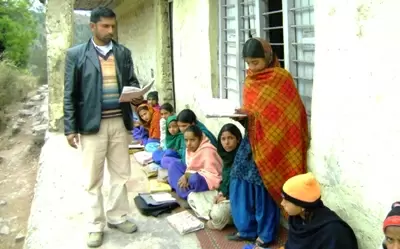
Keen to learn: Students of Govind High School trek for two hours to reach school that lacks adequate classrooms. But they are determined to continue their studies (Photo: Women's Feature Service)
|
A significant aspect of this institution is that it has over 200 students, but what makes it special is that it has more girls than boys in its classrooms. These girls come from the villages that surround Kotranka town. It could take two hours or more of non-stop walking to reach school, but fuelled by dreams of the future, these young women put up with the tough terrain and inclement weather to clock in each school day at 10 am.
Zarina Begum, 15, of Class X from Kha village, says: “Education is the only way girls can bring some change. I want to be a teacher so that I can help other girls step out of their homes and achieve their ambitions. We live in such a remote place that it takes me two to three hours to reach school. I come with a few other girls from my village. We walk as a group and just love school, because it brings the wider world to us.”
Shakuntala Devi, 14, from Kanthol village, who is currently studying in Class IX, is particularly lucky. The petite and confident girl explains why, “I am the first of the daughters in my family to come to this school. Luckily, my parents agreed to send me so far. My three elder sisters were not allowed to come, so I know how important this education is for me.”
But does it not bother her that she has to wake up early every day and trudge for two hours, crossing jungle land and bad roads, to reach school? “No. I love to study science, which is being taught here. So I will come however long it takes me. I want to be a doctor. There are no doctors or hospitals in my village and we face a lot of problems,” reveals Shakuntala.
What remains the biggest problem, however, is ensuring that the girls of Class X get to take their Higher Secondary Board Examinations every year, because this entails travelling a distance of 30 to 35 kilometres to reach Dangri – a town even further than Rajouri – where the examination centres are located. Despite the hurdles, though, no student has ever missed an examination, according to Mohammed Bashir, 16, who has himself passed out of this school, and now observes his nine-year-old sister making her way through it.
Says Bashir, “It is very essential for girls in our communities to be educated because that’s the only way they will be able to make a place for themselves. So the girls go and take their examinations even if they have to change three buses to reach the centre.”
Women's Feature Service
- 0
-

-

-

-


Trending Now: