‘Right to Education does not mean right to children’s access to school alone’

17-February-2012
Vol 3 | Issue 7
Manjula arrived at the tuition centre at 6:00 P.M. There were over 20 children waiting for her, few seeming exhausted after play.
“Can you teach me subtraction, please?” asked Kasi opening his mathematics book. Manjula was pleased to know that her student was eager to learn. She wrote on the black board ‘17 - 8’, and asked Kasi to solve this problem.
 |
|
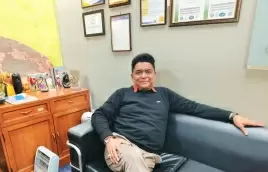
AID India founded by Balaji Sampath, an Asoka Fellow, works among rural children
|
Kasi counted his ten fingers, and looking at his toes continued to count until 17.
“What are you doing?” asked Manjula. “I am subtracting, Miss,” replied Kasi.
Manjula drew him nearer and taught him to solve this problem quicker. She held his hand and told: “Start counting after 8 and stop when you reach 17.” When Kasi finished, she asked: “What is the answer?” “It is 9, Miss,” said an excited Kasi.
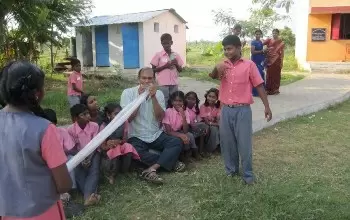
Manjula, Aid India volunteer, spends her evenings during weekends at Kalpakkam village, about 70 km from Chennai, to teach the poor children to read and write.
“I have been volunteering for this centre for over two years now. Teaching children mathematics and English through simple methods motivates them, and I thoroughly enjoy their company,” she said cheerfully.
Aid India was founded by Balaji Sampath, an Asoka Fellow, in 1996. After completing his B.Tech in IIT Madras, and PhD in Maryland University at the US, Balaji decided to work full-time on education, health, and livelihood for the rural children.
Currently, Aid India reaches to over 60,000 children. Cumulatively over the years Aid India programs have impacted over two million children.
Having won several accolades including the Times of India Social Impact Awards in 2011, Aid India is now striving to create awareness on the quality of education that is being provided in rural India. Their objective is to increase resources that would help to improve the quality of education.
“Although there are educational institutions—government schools; low cost private schools; community run schools; and NGO run schools—that cater to the poorer children, we observed that there was an issue of quality in all of these services. Aid India therefore worked towards developing substantial material on low cost, and good quality teaching pedagogy to provide the right teaching inputs to children,” said Balaji Sampath.
Reminiscing the early years of Aid India, Balaji stated: “We first focused on building a team in Tamil Nadu—volunteer base, and NGO partners. It is only for the last 7 to 8 years that we have been focusing exclusively on education.
“We mobilized volunteers from software companies and students from IIT, BITS, and Madras University who had engineering and social science backgrounds. Our core area of work was to teach children an easy method of learning science, mathematics, and English.”
“Our focus has always been poorer children, and we ensured that our methodology was simple for them to understand. We worked with teachers—government school teachers; and teachers who were not qualified but worked in difficult circumstances and communities.
“A few village schools had also asked us to train their teachers, put in processes, and make their school in an overall much higher level that it was. We developed pedagogy, methods and materials which ensured that the quality of learning levels of children increased.”
Besides Science and Mathematics, Aid India also researched on spoken English in over 100 schools across the State.
“Most NGOs have focused on children’s access to education, while ours have been to ensure best quality learning for children. Working on modules is a continuous process. We recently printed one lakh books in English and Tamil and distributed them to rural children,” remarked Balaji.
He added: “Right to Education does not mean right to children’s access to school alone. Although 99 percent of the rural children in our State attend school, 53 percent of the children studying in fifth standard at government schools are unable to read; 47 percent of them unable to subtract. This shows the society, government, and education system's gross negligence.
“We are not talking of their ability to do algebra or fractions, but their problem in learning the basic skills. Most of these children are from marginalized communities, those whose parents are not able to help them in their studies or monitor them. As there is no public outcry and demand for better quality education this problem continues to exist. We want to get people to say— I care about it.” - Conversations
- 0
-

-

-

-


Trending Now: