Weakening the Tamils economically is yet another strategy of the Sri Lankan govt
18-August-2011
Vol 2 | Issue 33
In a bid to prevent the Tamils from prospering in future, the Sri Lankan State is systematically destroying the self reliant local economic structures built over the years. As the local economy is being systematically dismantled, the hold of the Sinhalese businessmen is increasing in the region.
Trying to rebuild their lives from the ruins of a bloody civil war, Tamils have been pushed to do all kinds of odd jobs to survive. Forced by circumstances, even women have taken up jobs in the de-mining work currently going on in the region.
 |
|
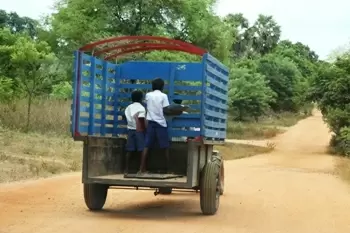
Road to nowhere: Two years after end of civil war, Tamils are yet to get back to a normal life
|
It was pathetic to see young Tamil women approaching the giant tank on Cheddikulam – Mannar road for fishing, as early as 4 in the morning. Many of them, we learned, were young widows who had taken to fishing to support their families.
Sinhalese shops have sprouted in Tamil areas. In Jaffna, the trend is more visible, where an estimated 5000 Sinhalese visit the town daily.
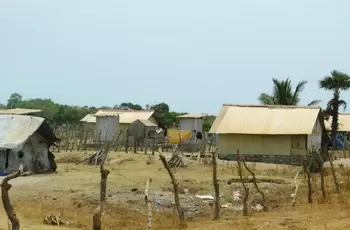
Rehabilitation remains a pipedream to the displaced Tamils, who are doled out a meager 25,000 LKR (Lankan Rupees), 6 bamboo poles, and 6 tin roofs to build their houses. With this assistance, the Tamils are able to build only temporary sheds. On the contrary, the Sinhala re-settlers are allowed to build permanent houses.
Adding to their cup of woes is the presence of high security zones in paddy fields and fishing areas where the Tamils cannot return.
 |
|
Housing in shambles: Tamils find it hard to build a decent shelter with the 25000 LKR (Lankan Rupees) they receive from the government
|
The long years of leaving the land uncultivated has made it barren. The planting of landmines and shelling over the land have had a heavy toll on the fertility of the soil.
The never ending security restrictions continue to haunt the Tamils, as two years after the end of the war they are still unable to get on with a semblance of normal life. Tamil fishermen need to obtain work permit to enter the sea. The application form for individual permit requires 12 signatures - 5 signatures of local village officers, local administration and fisheries department officials and 7 signatures of military and navy personnel, including intelligence officials.
The process takes 1-2 months and the fishermen have to spend anywhere between 15-20 thousand LKR (Lankan Rupees) to get a permit. The same process needs to be done for the fishing vessels too. Even after such an effort, the Tamil fishermen can fish only in a designated, narrow region in the sea; and cannot venture into deeper waters. Breaking rules would mean cancellation of permits.
In places like Mullaithivu, the Sinhala fishermen are allowed to fish but not the Tamils.
The Murunkan – Nanattan belt was once famous for banana cultivation and export. The war has left the land barren to such an extent that the locals are forced to buy imported bananas that come via Colombo through Sinhalese traders.
 |
|
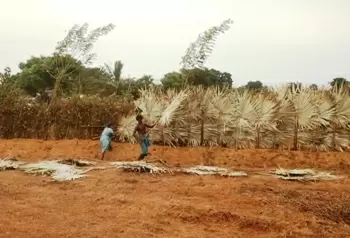
Rebuilding from the ruins: A Tamil family using Palmyra fronds to fence their plot
|
The loot of the jungles in the interior areas of the Tamil heartland continues unabated in connivance with the local military officials who allow the Sinhalese from the south to log timber.
The once bustling economy around the humble Palmyra tree has been affected most. The Palmyra is called karpaha (celestial tree), since all its parts can be used. When the fruit is tender, the kernel inside the hard shell is an edible jelly that is refreshing and rich in minerals.
Its other byproducts include toddy, sugar and jiggery. The Palmyra fronds are used to build thatched houses, fences, mats, baskets, hand fans, and umbrellas.
An estimated four million Palmyra trees had been destroyed in the two-decade civil war. All those families which depended on the trees for their livelihood have been left to fend for themselves.
Even if Palmyra saplings are planted now, it will take 60 years for the trees to grow and start yielding.
('Inside Lanka' series Concluded)
Also Read
Inside Lanka (Part I)
Inside Lanka (Part II)
- 0
-

-

-

-


Trending Now: